
How to Implement Effective Parking Lot Surveillance Cameras in San Diego (2026)
Property crime accounted for 55% of all reported incidents in the San Diego region throughout 2024, leaving many managers wondering if their current security measures actually work. You likely feel the pressure of rising costs for physical guards and the persistent threat of catalytic converter theft that plagues Southern California lots. While the City of San Diego reported a 22% decline in motor vehicle theft in 2025 due to advanced technology, passive recording systems still leave you vulnerable to liability claims and unauthorized encampments. The challenge is securing your perimeter without overspending or violating the evolving TRUST ordinance regulations set for September 2026.
This professional guide details how to implement effective parking lot surveillance cameras San Diego property managers can use to transition from reactive recording to proactive deterrence. We’ll show you how to design a system that utilizes virtual guarding and mobile surveillance units to stop intruders before they cause damage. You’ll learn to deploy sophisticated IP camera systems that provide clear evidence for SDPD investigations while potentially reducing your insurance premiums. We’ll examine the strategic integration of live video monitoring and real-time alerts to ensure your facility remains a high-tier, crime-deterrent environment.
Key Takeaways
- Identify specific property vulnerabilities through a systematic security assessment of entry points and environmental lighting conditions.
- Select the optimal hardware by comparing the long-term benefits of fixed IP systems against the rapid deployment of mobile surveillance units for temporary sites.
- Ensure full legal compliance by understanding how the San Diego TRUST ordinance and California signage requirements affect your parking lot surveillance cameras San Diego installation.
- Transition from passive recording to active deterrence using live video monitoring and remote guarding to intervene in criminal activity before damage occurs.
- Strengthen your defense against liability claims and unauthorized encampments with high-definition evidence that meets SDPD investigative standards.
The State of Parking Lot Security in San Diego (2026)
Understanding the history of video surveillance shows how the industry has shifted from simple analog recording to integrated digital intelligence. Modern parking lot surveillance cameras San Diego businesses utilize today must do more than just document events; they must provide actionable data. The financial impact of a security breach extends beyond the immediate loss. High insurance premiums and the cost of property damage often outweigh the initial investment in advanced surveillance ROI. By transitioning to proactive systems, property managers can secure their perimeter while maintaining clear boundaries between public street surveillance and private property rights. This distinction is vital as San Diego continues to refine the TRUST ordinance, emphasizing the need for private entities to manage their own high-tier security solutions independently.
Addressing the Catalytic Converter Crisis in Southern California
San Diego continues to be a hotspot for vehicle parts theft due to its high density of commuter vehicles and easy freeway access. Thieves exploit “blind spots” in typical lot layouts, such as corners with poor lighting or areas behind large structural pillars. Advanced parking lot surveillance cameras San Diego firms deploy now include high-resolution thermal imaging. This technology identifies the heat signatures of individuals moving through a lot in total darkness, allowing for detection where traditional sensors fail. These systems provide the clarity needed to identify suspects even in the most challenging environmental conditions.
Liability and Risk Management for Property Managers
Surveillance isn’t just about stopping thieves; it’s a critical tool for managing liability. In cities like Chula Vista and Oceanside, property managers use high-definition footage to mitigate “slip and fall” fraud and resolve vehicle damage disputes between tenants. Clear documentation protects your bottom line and your reputation. To ensure your facility is fully protected, your system should align with a comprehensive business security assessment San Diego professionals recommend. This approach ensures every square foot of your lot is accounted for and monitored, leaving no room for fraudulent claims or unrecorded incidents.
Evaluating Your Property: A Step-by-Step Security Assessment
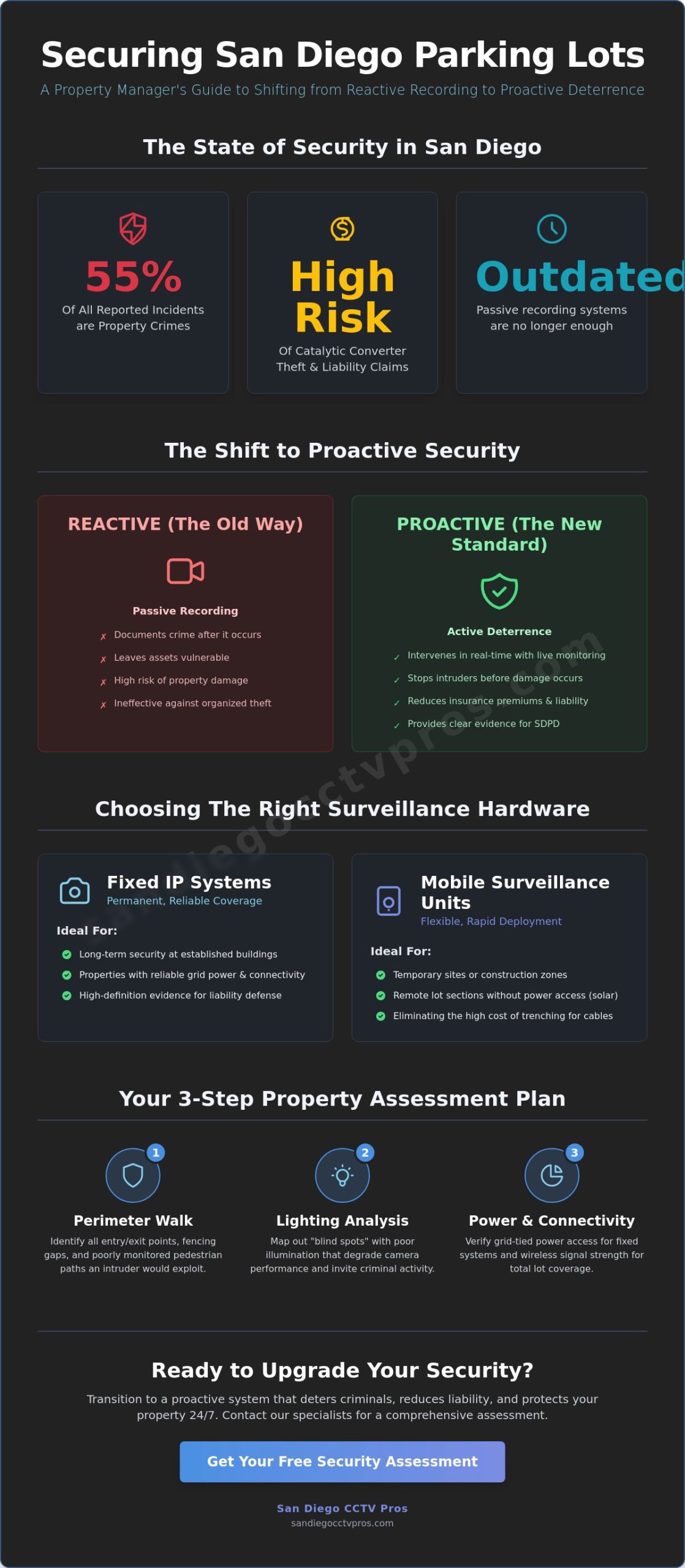
Effective security starts with a physical perimeter walk. You should walk your property exactly as an intruder would, identifying every potential entry and exit point. Standard gates are often insufficient because professional thieves exploit gaps in fencing or poorly monitored pedestrian paths that aren’t visible from the main office. During this walk, pay close attention to lighting. Poor illumination doesn’t just invite crime; it significantly degrades the performance of standard camera sensors. While modern parking lot surveillance cameras San Diego installations often feature advanced low-light technology, consistent ambient light remains the best way to ensure high-quality forensic evidence for local authorities.
Power and connectivity are the next logical hurdles. For established commercial buildings, grid-tied IP camera systems provide permanent reliability. However, for remote sections of a lot or temporary overflow areas, solar-powered mobile surveillance units offer a rapid solution without the high cost of trenching for cables. You should also consult with a local integrator to verify wireless signal strength across the property. San Diego’s varied topography and urban interference can disrupt camera feeds if the wireless backbone isn’t properly engineered. For a comprehensive look at your property’s specific needs, scheduling a professional CCTV installation assessment is the most efficient way to determine the exact hardware count required for total coverage.
Identifying Critical Camera Placements
Entry and exit points are your highest priority zones. These areas require dedicated LPR cameras to capture plates as vehicles pass. It’s vital to follow California ALPR regulations to ensure your data collection remains legally compliant. Beyond the gates, use the “Cross-Fire” method. This involves positioning cameras so that every unit’s blind spot is covered by another camera’s field of view. Mount your hardware at a height of 10 to 15 feet; this is high enough to prevent vandalism but low enough to maintain a useful angle for facial recognition.
Calculating Coverage Needs for Large Lots
Large lots require a strategic mix of hardware to be cost-effective. While PTZ cameras are excellent for active tracking, they can only look in one direction at a time, potentially missing activity elsewhere. Fixed wide-angle lenses provide constant coverage of high-traffic zones and long-term parking areas where catalytic converter theft is most likely. To achieve the necessary pixel density for identifying a human face at a distance of 50 feet, a 12mm focal length on a high-definition 4K sensor is generally required. Mapping your lot into zones based on traffic volume helps prioritize where to deploy high-resolution parking lot surveillance cameras San Diego assets versus standard coverage units.
Comparing Fixed IP Systems vs. Mobile Surveillance Units
Choosing the right hardware architecture for parking lot surveillance cameras San Diego depends entirely on your site’s longevity and existing infrastructure. Property managers must weigh the immediate agility of mobile units against the deep integration and long-term stability of fixed IP systems. While some providers suggest one solution fits all, a strategic approach requires matching the technology to the specific environment. Your decision impacts everything from your initial capital expenditure to the quality of the data your security team receives.
Fixed IP systems represent the gold standard for permanent commercial buildings and high-traffic retail centers. These systems integrate directly into your building’s existing network and access control protocols, creating a unified security ecosystem. Because they rely on hardwired power and data, they offer superior bandwidth. This capacity is necessary for running 4K streams and sophisticated AI-driven analytics that detect loitering or unauthorized vehicle entries in real-time. It’s a disciplined approach for those who view security as a permanent part of their operational infrastructure.
Mobile surveillance units offer a different value proposition centered on flexibility and speed. These are ideal for construction sites or temporary event overflow where trenching for power and data is cost-prohibitive. From a financial perspective, fixed systems require more upfront capital for infrastructure, but they deliver a lower Total Cost of Ownership (TCO) over multi-year operations. Mobile units typically operate on a rental model, providing monthly flexibility for projects with a defined end date or shifting security needs.
When to Deploy Mobile Surveillance Trailers in San Diego
Rapid deployment is essential when managing high-crime hotspots in areas like El Cajon or Escondido. If a property experiences a sudden spike in vandalism, mobile trailers can be positioned within hours to provide an immediate visual deterrent. These units often feature solar-powered arrays, making them completely self-sufficient in lots without existing electrical infrastructure. For property managers overseeing active development, reviewing the mobile surveillance units for construction sites technical specifications helps determine which sensor packages are best for rugged environments.
The Benefits of Permanent IP Camera Installations
Permanent installations offer higher aesthetic value, which is a priority for luxury retail centers and Del Mar office parks. Beyond appearance, these systems provide the most reliable platform for advanced features like automated license plate recognition. When implementing these tools, you must ensure your data management policies align with the California ALPR Privacy Law to protect your business from regulatory scrutiny. Fixed systems are the proactive choice for firms looking to invest in a high-performance security backbone that scales with their long-term needs.
Navigating Privacy Regulations and ALPR Technology
Public debate regarding Automated License Plate Recognition (ALPR) has intensified across San Diego County, largely due to the Transparent and Responsible Use of Surveillance Technology (TRUST) ordinance. While city agencies face a September 2026 deadline for technology reviews, private property managers operate under a different set of legal requirements. Implementing parking lot surveillance cameras San Diego businesses can trust requires a balance between rigorous security and respecting the privacy of tenants and visitors. You aren’t just installing hardware; you’re managing a sensitive data ecosystem that must be handled with professional discipline.
A common point of confusion is the distinction between public “Flock” systems used by law enforcement and private LPR databases. Public systems are designed for broad investigative tracking across city streets. In contrast, your private system remains under your exclusive control. Private LPR data in San Diego is not automatically shared with law enforcement without a warrant. This distinction is critical for maintaining the trust of your tenants while still capturing the high-definition plate data necessary to stop crime. Effective data retention policies typically involve purging non-essential footage after 30 days, mirroring the SDPD’s own internal standards for ALPR data management.
Clear communication is the best defense against privacy disputes. California law requires visible signage that provides a “Notice of Surveillance” to anyone entering the property. These signs should be placed at every vehicle entrance and pedestrian walkway identified during your initial perimeter walk. If you have questions about the specific legal requirements for your facility, it’s best to consult with a commercial surveillance specialist who understands Southern California’s unique regulatory environment.
Ethical Implementation of License Plate Recognition
LPR technology is most effective when used for “White-Listing” authorized tenant vehicles. This allows your security team to receive immediate alerts only when an unrecognized or “black-listed” vehicle enters the premises. Securing this data is paramount. You must use encrypted storage solutions to prevent “open database” leaks that could expose tenant habits. A disciplined approach to data security ensures that your parking lot surveillance cameras San Diego system remains a protective asset rather than a legal liability.
Compliance Checklist for Southern California Businesses
Maintaining a professional security posture requires ongoing attention to privacy details. Your installation must include digital masking to ensure cameras don’t peer into adjacent residential windows, which is a common legal pitfall in high-density areas like North Park or Little Italy. Part of this compliance involves clear signage; Banner 4 Sale can provide the necessary custom signs to alert the public of your surveillance measures. Follow this checklist to maintain compliance:
- Privacy Policy: Develop a written document for employees and customers explaining how surveillance data is used and stored.
- Access Audits: Perform regular audits of system access logs to ensure only authorized personnel are viewing recorded footage.
- Signage Visibility: Ensure all “Notice of Surveillance” signs are well-lit, unobstructed by landscaping, and clearly legible from a distance.
Proactive Protection: Integrating Live Video Monitoring
Passive recording is no longer a sufficient defense against sophisticated theft rings. While high-definition footage helps with investigations, it does little to stop a crime in progress. The most significant advancement in parking lot surveillance cameras San Diego property managers can implement is the integration of live video monitoring San Diego services. This technology shifts the security posture from documenting past events to active, real-time intervention. By combining advanced sensors with professional oversight, you ensure that your property is never truly unattended.
A critical component of this proactive strategy is the “Voice-to-Skull” effect. This involves using high-output, integrated speakers to deliver live talk-down warnings to trespassers. When an operator identifies unauthorized activity, they can address the individual directly. Most opportunistic criminals flee the moment they realize they’re being watched and recorded by a live person. This immediate deterrent often prevents the need for law enforcement involvement or costly property repairs. To maintain precision, modern systems utilize AI-driven alerts that filter out environmental triggers like wind, swaying branches, or roaming animals. This ensures that monitoring efforts remain focused exclusively on genuine human threats.
Virtual Guarding vs. Physical Patrols
Many property managers find that virtual guarding offers a superior return on investment compared to traditional on-site personnel. Transitioning to remote guarding can result in savings of up to 60% when compared to the high cost of physical security guards. Digital monitoring eliminates the risks of “guard fatigue” and the significant liability issues associated with having physical personnel on-site. Furthermore, digital systems provide faster response times through direct, high-priority coordination with local dispatch. You get more eyes on the property for a fraction of the traditional overhead.
Getting Started with San Diego CCTV Pros
San Diego CCTV Pros serves as a dedicated local partner with deep expertise in the San Diego, Carlsbad, and Chula Vista commercial markets. We understand that every parking lot has a unique topography and specific security challenges. We don’t believe in one-size-fits-all solutions. Instead, we focus on customized system design that accounts for your specific layout, lighting conditions, and tenant needs. Our team provides the technical discipline required to deploy high-tier parking lot surveillance cameras San Diego businesses depend on for long-term safety. The next step in securing your facility is scheduling a professional site walkthrough to identify your property’s specific vulnerabilities and design a proactive defense plan.
Securing Your Property with Proactive Intelligence
Securing your commercial asset requires a shift from simple recording to a disciplined, proactive defense strategy. We’ve detailed how a systematic site assessment identifies vulnerabilities and why selecting the right architecture, whether fixed IP systems or mobile units, determines long-term success. By integrating live video monitoring and adhering to local privacy standards, you protect your bottom line while fostering a safe environment for tenants and visitors.
Effective parking lot surveillance cameras San Diego property managers rely on must be backed by local expertise and modern technology. Since 2008, we’ve specialized in NDAA-compliant IP systems designed to withstand the unique challenges of the Southern California market. Our team provides the technical precision of virtual guarding and live talk-down services to stop criminal activity before it escalates. Take control of your facility’s safety today. Request Your Professional San Diego Parking Lot Security Assessment to ensure your property remains a secure, high-tier environment. Your peace of mind starts with a vigilant, tech-forward guardian.
Frequently Asked Questions
Are parking lot cameras legal in San Diego private businesses?
Yes, installing surveillance technology on private property is entirely legal in San Diego, provided you comply with California privacy laws. You must avoid capturing areas where individuals have a reasonable expectation of privacy, such as locker rooms or adjacent residential windows. Additionally, you’re required to post clear “Notice of Surveillance” signage at all vehicle and pedestrian entrances to inform visitors they’re being recorded.
How much does a commercial parking lot surveillance system cost in 2026?
The total investment for a commercial system depends on several technical factors, including the number of camera nodes, the choice between local or cloud storage, and the complexity of the network infrastructure. While hardware prices vary, property managers should focus on the long-term value of high-tier equipment that offers 4K resolution and AI analytics. Factors like trenching for wires or opting for solar-powered mobile units will also influence the final project scope.
Can surveillance cameras read license plates at night in low light?
Dedicated Automated License Plate Recognition (ALPR) cameras are specifically engineered to capture plates in total darkness. These units use infrared illuminators and specialized shutter speeds to overcome the glare from vehicle headlights and tail lights. When you implement parking lot surveillance cameras San Diego experts recommend, you ensure the system captures crisp, high-contrast images of alphanumeric characters even in challenging environmental conditions.
What is the best camera resolution for a large outdoor parking lot?
4K resolution, also known as 8 Megapixels, is the professional standard for large outdoor environments. This high pixel density allows security operators to zoom into recorded footage to identify faces or vehicle markings without the image becoming pixelated. For massive lots, a strategic mix of 4K fixed-lens cameras for wide areas and high-speed PTZ units for active tracking provides the most comprehensive coverage.
Do I need a permit to install security cameras in my San Diego business lot?
Standard camera installations typically don’t require a specific security permit from the City of San Diego. However, if your project involves significant electrical work, trenching through public right-of-ways, or erecting new 20-foot mounting poles, you may need to consult with the Development Services Department for building or electrical permits. It’s always best to check local zoning codes if you’re making structural changes to the property.
How does live video monitoring differ from standard CCTV recording?
Standard CCTV is a reactive tool that records events for later review, which often means you only discover damage after the intruder has left. Live video monitoring is a proactive service where professional operators watch your feeds in real-time. This allows for immediate intervention through live talk-down speakers, stopping criminal activity like catalytic converter theft before the suspect can finish the job.
What happens if a crime is caught on my camera in San Diego?
If your parking lot surveillance cameras San Diego system captures a crime, you should immediately secure the footage and prevent it from being overwritten. Contact the San Diego Police Department to file a report and provide them with a high-definition digital export of the incident. Systems integrated with virtual guarding services often have the advantage of notifying dispatch while the crime is still in progress, increasing the likelihood of an on-site apprehension.
Are solar-powered security cameras reliable in San Diego weather?
Solar-powered units are exceptionally reliable in San Diego due to the region’s high average of sunny days. These systems are designed with high-capacity battery backups that keep the cameras operational during overcast periods or throughout the night. They’re a disciplined choice for remote lot perimeters or construction sites where traditional power infrastructure is unavailable or too expensive to install.