
Warehouse Security Camera Systems: A 2026 Case Study in Proactive Logistics Protection
Did you know that cargo theft across North America surged by 15% in 2022, resulting in over $223 million in lost inventory? For many facility managers, implementing effective warehouse security camera systems is no longer just about compliance; it’s about survival. You’re likely facing the high cost of on-site guards and persistent blind spots in your high-rack aisles. It’s frustrating when your current surveillance only records a crime after the damage is done, leaving you to deal with insurance liability and lost revenue.
This 2026 case study reveals how modern IP camera systems and virtual guarding services shift the focus from passive recording to active crime prevention. You’ll discover how live video monitoring and AI-driven analytics provide real-time threat detection while helping to reduce insurance premiums. We’ll preview how these advanced technologies provide clear evidence for liability claims and ensure your logistics hub remains secure. This guide outlines a professional, no-nonsense approach to protecting your assets with the latest in remote guarding innovation.
Key Takeaways
- Understand how modern warehouse security camera systems evolve from simple forensic tools into proactive deterrents that stop intruders in their tracks.
- Identify the critical technical components of enterprise-grade IP surveillance, including AI analytics that distinguish between routine operations and genuine security threats.
- Explore how live video monitoring provides a cost-effective alternative to physical guards while maintaining high-level oversight for large logistics facilities.
- Learn strategic placement techniques for maximizing visibility in complex warehouse layouts, specifically focusing on high-value cages and loading docks.
- Navigate essential regulatory requirements for 2026, including NDAA compliance and the importance of professional site assessments for Southern California businesses.
Scaling Security: Why Traditional Warehouse Surveillance Fails in 2026
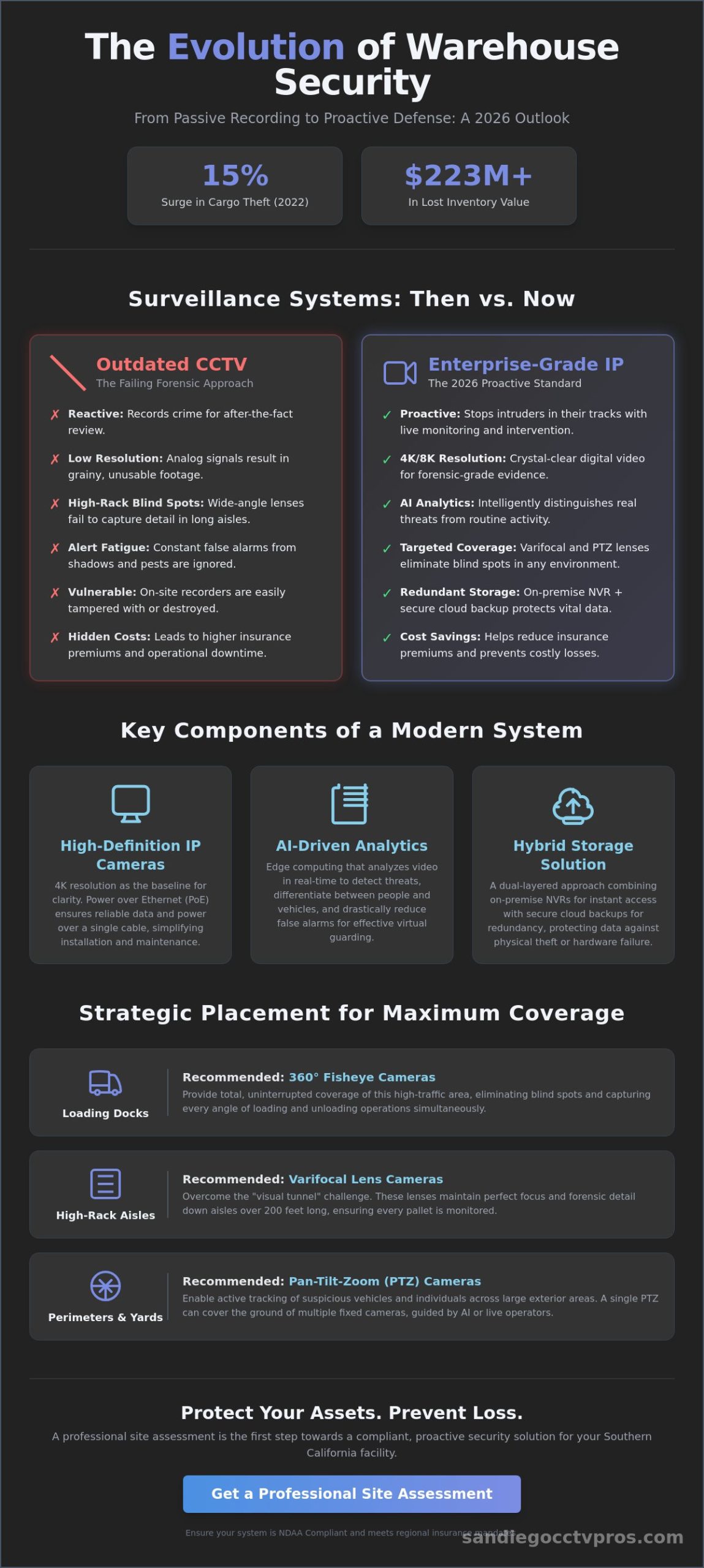
Traditional security models are becoming obsolete. In the current logistics environment, simply reviewing Closed-circuit television (CCTV) footage of a theft that occurred days ago doesn’t protect your bottom line. It’s a forensic approach that documents loss rather than preventing it. Modern warehouse security camera systems have transitioned from passive recording tools into proactive threat management platforms. This shift is essential because cargo theft across North America saw a 15% increase in 2022, resulting in over $223 million in stolen products. If your system isn’t stopping the crime in progress, it isn’t doing its job.
Many facility managers initially consider consumer-grade DIY kits to save on upfront costs. This is a mistake. Industrial environments demand hardware that can handle dust, extreme temperature fluctuations, and high-vibration areas near loading docks. Residential cameras lack the processing power for advanced edge computing and AI analytics, which are standard in 2026. Without these features, your team is buried in false alarms caused by shifting shadows or warehouse pests, leading to “alert fatigue” and missed genuine threats.
The real cost of warehouse shrinkage in Southern California extends beyond the lost inventory. It includes increased insurance premiums, operational downtime, and damage to your reputation with high-value clients. Relying on passive cameras is an incomplete solution that leaves your facility vulnerable during the most critical hours of the night.
The High-Rack Blind Spot Challenge
Modern logistics facilities often utilize 30-foot racking systems that create narrow, deep visual tunnels. Standard wide-angle lenses, while useful for open areas, fail in these aisles because they can’t provide the necessary detail at a distance. In these environments, focal length is more critical than megapixel count. Professional warehouse security camera systems use varifocal lenses and specialized sensors to maintain clarity across a 200-foot aisle, ensuring that every pallet movement is documented with forensic precision.
Local Risks for San Diego Logistics Hubs
San Diego’s industrial landscape presents unique security requirements. Facilities in Otay Mesa and Chula Vista are primary targets due to their proximity to international trade routes and the Port of San Diego. Regional insurance mandates for high-value inventory often require more than just basic coverage. To meet these standards and reduce premiums, local businesses are moving toward integrated solutions that combine high-definition IP cameras with live monitoring. This local expertise ensures your system is compliant with both regional security standards and federal NDAA regulations.
The Core Components of Enterprise-Grade IP Surveillance
Modern warehouse security camera systems rely on high-definition IP (Internet Protocol) architecture to deliver the clarity required for industrial protection. As of 2026, 4K resolution has become the baseline for new installations, while 8K sensors are utilized for high-end applications requiring forensic detail over long distances. Unlike legacy analog systems that suffer from signal degradation and low resolution, IP cameras transmit digital data and power over a single cable. This Power over Ethernet (PoE) standard is the backbone of any reliable 2026 deployment, ensuring consistent image quality and easier scalability across facilities that often exceed 100,000 square feet.
Storage architecture has also evolved into a hybrid model. While on-premise Network Video Recorders (NVRs) provide high-speed local access and zero-latency recording, secure cloud backups offer essential redundancy. This dual-layered approach protects your data against physical tampering or hardware failure. For businesses requiring a customized hardware roadmap, a professional CCTV installation assessment ensures your network infrastructure can handle the massive bandwidth demands of multiple 4K streams without compromising your operational data flow.
Advanced Camera Types for Warehouse Layouts
Selecting the right hardware depends on the specific environment. Pan-Tilt-Zoom (PTZ) cameras are ideal for active perimeter tracking, allowing operators to follow suspicious vehicles across a yard. In contrast, fisheye and 360-degree cameras provide total loading dock coverage, eliminating the “stitched” look of older multi-camera setups. For after-hours detection in unlit yards, thermal imaging sensors identify heat signatures, providing a layer of security that traditional optical cameras can’t match. Integrating these tools requires an Effective Site Security Design to ensure no critical entry point remains unmonitored.
AI-Driven Analytics and Object Classification
The most significant advancement in 2026 is the integration of AI and edge computing directly into the hardware. Statistics show that 90% of new security cameras now feature built-in AI capable of distinguishing between humans, vehicles, and inanimate objects like blowing debris or shadows. This object classification drastically reduces false alarms, which were a major pain point for older warehouse security camera systems. Advanced features like loitering detection and line-crossing alerts notify security personnel the moment a restricted zone is breached. Additionally, License Plate Recognition (LPR) technology automates gate management, logging every trailer that enters or exits the facility with timestamped accuracy.
Case Study: Transforming Warehouse Defense with Live Video Monitoring
A 100,000 square foot logistics facility in Escondido recently faced a critical security crisis. Despite employing on-site night guards, the facility suffered from recurring yard theft and unauthorized trespassing. The sheer scale of the property meant that human patrols left significant gaps in coverage, which criminals easily exploited. By modernizing their warehouse security camera systems and implementing live video monitoring San Diego, the facility transformed its defense strategy from reactive to proactive. The transition replaced expensive physical patrols with a high-definition 4K camera network integrated with virtual guarding services.
The results were immediate and measurable. Within the first quarter of implementation, the facility reported a 100% reduction in successful trespasses. Beyond the enhanced security, the business realized a 60% reduction in security overhead costs. This case study demonstrates that technology, when correctly deployed, outperforms traditional methods by providing total site visibility without the liability or expense of 24/7 on-site personnel. It’s a strategic shift that prioritizes prevention over evidence collection.
Virtual Guarding vs. Traditional Physical Patrols
Traditional physical patrols are limited by human biology. Guards require breaks, can only view one area at a time, and represent a significant insurance liability. Virtual guarding services eliminate these vulnerabilities. A centralized monitoring station uses advanced warehouse security camera systems to view every corner of the facility simultaneously. When the AI detects movement, a professional monitor investigates in real-time. This approach ensures that response times are measured in seconds, not minutes. Digital “talk-down” services allow monitors to address intruders directly, stopping most crimes before a fence is even breached.
The Role of Live Talk-Down Technology
One of the most effective tools in the modern security arsenal is live talk-down technology. This system uses integrated speakers to deliver a direct, human warning to anyone detected in a restricted zone. The psychological impact of an immediate human voice intervention is profound. Most trespassers flee the moment they realize they’re being watched and recorded in real-time. If the intruder persists, the monitoring team coordinates directly with local San Diego law enforcement. Because the crime is verified via live video, police often provide a priority response, significantly increasing the likelihood of an apprehension.
Strategic Placement: Maximizing Coverage in High-Rack Environments
Designing a layout for warehouse security camera systems requires more than just mounting hardware at every exit. To achieve comprehensive coverage, a typical 100,000 square foot facility requires between 25 and 40 cameras, strategically positioned to eliminate blind spots created by high-density racking. Strategic placement ensures that every pallet movement is tracked from the moment it enters the loading dock until it’s secured in a high-value cage. By focusing on critical transition points, you create a seamless digital chain of custody that simplifies liability claims and internal investigations. This high standard of facility care is essential for all structural elements; for example, specialists like Svenska trappsteg help businesses maintain safe and professional stairways, ensuring every part of the site is up to code.
High-value cages require multi-angle coverage to prevent internal loss, while mezzanines and stairwells need targeted surveillance to eliminate hidden paths for unauthorized access. For exterior yard protection, mobile surveillance units offer an agile solution for monitoring perimeter fencing where hardwired infrastructure isn’t feasible. These units provide the same high-definition clarity as interior systems but with the flexibility to adapt to changing yard configurations. If you’re ready to eliminate the gaps in your facility’s defense, consider a professional commercial camera installation to ensure every square foot is accounted for.
Optimizing Loading Dock Surveillance
Loading docks are high-traffic zones where most security breaches occur. Effective surveillance here involves mounting cameras at specific heights and angles to see deep inside trailers, capturing both the inventory and the trailer’s license plate. Integrating your video feed with access control systems allows for automatic door-open alerts, which helps prevent unauthorized entries. Beyond security, these cameras monitor for OSHA compliance, providing clear evidence of workplace safety standards being met during high-pressure shifts.
Aisle and Racking Coverage Tactics
High-rack environments present the “tunnel effect,” where standard aspect ratios waste a significant portion of the frame on useless racking. Modern warehouse security camera systems solve this using “Corridor Mode,” which rotates the image 90 degrees to focus entirely on the long, narrow aisle. Using varifocal lenses allows your team to zoom in on specific rack levels for high-detail inventory checks. To complement this visual precision, utilizing high-quality labeling supplies from DymoOnline ensures that rack identifiers and barcodes remain crisp and easy to read on your monitors, regardless of your facility’s location. It’s also vital to account for high-contrast shadows. Wide Dynamic Range (WDR) sensors are essential in warehouse bays to ensure that activity in dark corners isn’t washed out by bright light from open bay doors.
Implementing Your Warehouse System with San Diego CCTV Pros
Securing a large scale logistics facility requires more than just high end hardware; it demands a strategic partner who understands the unique industrial landscape of Southern California. Professional site assessments are the foundation of any successful deployment. We evaluate your specific risk profile, from high density racking blind spots to perimeter vulnerabilities. By choosing a local specialist, you ensure your warehouse security camera systems are designed to meet regional insurance requirements and operational challenges. Our team focuses on providing a sense of total control, allowing you to manage your facility with quiet confidence.
Compliance is a critical factor for modern enterprises. We prioritize NDAA Section 889 regulations, ensuring that all video surveillance equipment is free from restricted Chinese manufacturers like Hikvision or Dahua. This is essential for businesses that work with federal agencies or those that simply value higher cybersecurity standards and transparent supply chains. Beyond compliance, we focus on seamless integration. We combine advanced IP camera systems with virtual guarding and patrol services to create a unified defense network. This holistic approach ensures that your security isn’t just a collection of cameras, but a disciplined, results oriented system.
Future proofing your investment is just as important as the initial installation. We utilize scalable Network Video Recorders (NVRs) and secure cloud solutions that grow alongside your business. Whether you’re adding new bays or expanding to an additional facility in Irvine, your infrastructure remains robust and adaptable. This methodical approach respects your time and provides the necessary data to build a long term case for security excellence.
The San Diego CCTV Pros Deployment Process
Our process begins with a comprehensive technical site survey at your facility. We analyze floor plans and identify high value zones that require specialized coverage. Our engineers then create a custom system design that balances technical expertise with your specific safety goals. During the professional installation phase, we work efficiently to ensure minimal disruption to your daily warehouse operations. We understand that downtime is costly, so our teams maintain a disciplined schedule to get your system online and fully optimized as quickly as possible.
Ongoing Support and Remote Guarding
Reliability is the hallmark of a professional security partner. We provide ongoing system health monitoring and maintenance contracts to ensure your hardware performs at peak efficiency. Our virtual guard officers are specifically trained for industrial environments, offering a level of vigilance that traditional services can’t match. They act as tech savvy guardians, monitoring your feeds and responding to threats with precision. If you’re ready to transition from passive recording to active logistics protection, reach out for a professional audit of your current security infrastructure.
Securing the Future of Your Logistics Operations
Logistics protection in 2026 requires a disciplined shift from documenting losses to preventing them entirely. By integrating AI-driven hardware with live video monitoring, your facility gains a vigilant, tech-savvy guardian that never sleeps. Precision placement in high-rack environments and loading docks ensures that every pallet movement is accounted for, creating a seamless digital chain of custody that simplifies liability and insurance claims. Modern warehouse security camera systems are only as effective as the strategy behind their deployment. Navigating NDAA compliance and complex enterprise security standards requires a partner who understands the specific industrial challenges of Southern California.
San Diego CCTV Pros has provided local expertise since 2008. We specialize in virtual guarding and live monitoring solutions that reduce overhead while maximizing site safety with NDAA compliant enterprise technology. Don’t leave your inventory or your reputation to chance. Take the first step toward a more secure, efficient operation by scheduling a comprehensive review of your current infrastructure. Secure Your Facility with a Professional Warehouse Security Audit today. Protecting your assets and your peace of mind is within reach.
Frequently Asked Questions
What is the best security camera system for a large warehouse?
An enterprise-grade IP camera system using PoE architecture is the superior choice for large facilities. These systems offer 4K resolution and edge computing capabilities that allow for on-device object detection. This technology ensures that your security infrastructure remains scalable while providing the forensic detail necessary for identifying individuals or license plates at a distance.
How many cameras do I need for a 50,000 square foot warehouse?
A 50,000 square foot facility typically requires 15 to 25 cameras, depending on the complexity of your racking and the number of loading docks. While a 100,000 square foot warehouse often needs 25 to 40 units, smaller facilities still face the same blind spot challenges. A technical site survey is necessary to determine the exact number of warehouse security camera systems needed for total site visibility.
Can warehouse security cameras help reduce my insurance premiums?
Implementing advanced surveillance can lead to reduced insurance premiums by lowering the overall risk profile of your facility. Insurance companies often reward businesses that use live video monitoring because it prevents claims before they occur. Additionally, having high-definition evidence for workplace accidents helps resolve liability disputes quickly, which protects your business from fraudulent claims and rising rates.
What is the difference between passive recording and live video monitoring?
Passive recording stores video data on a hard drive for review after an incident has occurred. In contrast, live video monitoring involves professional guards watching your feeds in real-time. This proactive approach allows for immediate intervention through talk-down speakers, stopping intruders before they can cause damage or steal inventory. It transforms your security from a witness into a deterrent.
Are wireless security cameras reliable enough for industrial warehouses?
Wireless cameras are rarely reliable enough for industrial environments because metal racking and heavy machinery cause significant signal interference. For a stable 2026 deployment, hardwired PoE IP cameras are the industry standard. They provide consistent bandwidth for 4K streams and don’t suffer from the latency issues or battery failures common in consumer-grade wireless kits.
How long is warehouse security footage typically stored?
Most industrial facilities store footage for 30 to 90 days. This duration is often dictated by regional insurance mandates or internal loss prevention policies. Using a hybrid storage model with on-site NVRs and secure cloud backups ensures that footage of critical incidents is preserved even if the local hardware is tampered with or fails.
What are NDAA-compliant security cameras and why do they matter?
NDAA-compliant cameras meet the standards set by the National Defense Authorization Act, which restricts the use of specific Chinese-made telecommunications equipment from brands like Hikvision and Dahua. Using these cameras is vital for businesses with federal contracts. Even for private entities, NDAA compliance ensures a higher level of cybersecurity and a more transparent manufacturing process, protecting your network from potential vulnerabilities.
How do I prevent blind spots in my warehouse racking system?
Preventing blind spots in high-rack environments requires a combination of specialized lenses and Corridor Mode settings. This setting rotates the camera’s aspect ratio to focus on long, narrow aisles rather than wasting pixels on the racking itself. Strategic placement of warehouse security camera systems at the ends of every aisle ensures that no activity remains hidden from your security team.